

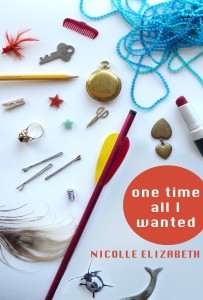
(Ann Arbor, MI: Keyhole Press, 2013)
Although she’s primarily a fiction writer, Nicolle Elizabeth’s latest offering, One Time All I Wanted, is a hybrid fiction memoir written in flash. Elizabeth’s nonlinear telling of the memories that detail her life mixes embarrassment, earnestness, humor, and sentiment to produce a deeply emotional and hearty work of art. The stories that make up this collection are short, minimalist interstitials, hyper-focused events drawn from the narrator’s life, often without context. Each brief story ponders experiences that loom large and small in day-to-day life. The stories are at times flip and seemingly arbitrary: here, Elizabeth falls off a chair lift, gets her stiletto stuck in a cobblestone crack, and dances alone in her kitchen singing along with the radio. There, we see her experience clear and essential moments that contribute to the shape and course of her life, like being diagnosed with an incurable disease.
one time i learned I have an incurable illness/one time i danced in the kitchen while singing along to Prince…one time i told you to grow out your beard like the old days and were going to get together on Christmas and then i brought a friend platonically to your party and you thought he was a date and then the rest of our lives were changed forever. /one time i figured the odds are shifting.
This juxtaposition of her illness with life’s banalities creates the atmosphere and mood of reality in a text that is largely experimental in form. The book is constructed so that when the reader reaches the conclusion, the whole is immediately understandable beyond its parts. When the mundane moments of too hot coffee or absent-mindedly walking into a street sign are offered in tandem with broken hearts and the frailty of life; those smaller moments start to sing and life draining struggles seem a bit more bearable. Each piece of flash from One Time All I Wanted may seem to be specific and singular while reading. However, completing the book is transformative, in the sense that the fragmented narrative is revealed to be part of a tightly connected larger arch.
Elizabeth’s style of prose creates a duality of concert reality and ridiculous hyperbole. Her voice is disembodied at times, but not ghostly. There is this sense that the reader is experiencing the raw feed from someone lost in thought: synapses fire, seemingly at random, causing recollections and provoking feelings. This gives the writing an extremely personal feel and creates a sense of emotional voyeurism. Reading One Time All I Wanted is almost like eavesdropping in on someone’s thoughts as if the words were overheard gossip.
i once loved you the whole way through./ one time i realized, if they don’t like you, they don’t like you./one time i agreed with you the whole time but you weren’t hearing me… i once survived a pretty horrific car crash…we hit black ice by a reservoir, and spun right out.
Through these overheard confessions, Elizabeth’s emphatically distant voice is given shape. A fully formed person with complicated and conflicting feelings is revealed. It is greatly satisfying to witness how she is manifested in the text. And, most of all, One Time All I Wanted is funny; funny in that deeply touching way that gives the reader no other choice, but to emotionally connect with the work.
# # #
Tim Waldron is an editor of Best New Writing.