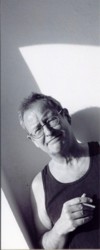
Thomas E. Kennedy
Kerrigan's Copenhagen:
A Love Story
Excerpts
Biography
Foreplay
God Is a What?
SAS Drinks on
Wheels on Wings
|
A Web Chapbook from
The Literary Review
Thomas E. Kennedy
Kerrigan's Copenhagen: A Love Story
GOD IS A WHAT ?!
Adventures in The Ditch, Foley's, the Mansion
A long walk on a chillish spring morning chases demons. For a time. Unshaven but bathed, Kerrigan hikes briskly, emerging from dreams of stolen gold and plundered churches, fleeing a fragment of memory that unnerves him. At Gammel Torv, he pauses to consider Caritas Springvanden, The Charity Fountain, Copenhagen's oldest surviving public monument, erected nearly four hundred years before. A pillar rises from the center on which stands Charity as the Virgo Lactans. The fountain's water flows from the virgin Charity's nipples.
Kerrigan thinks of the poem “Milk” by the Irish poet Moya Cannon:
Any stranger's baby
Crying in a street can start the flow…
This is kindness
which in all our human time
still knows nothing
but the depth of kinship,
of thirst.
His tongue writhes with thirst. Whiskey keepeth the reason from stifling, he thinks, trying not to think – of his mother in the locked ward five thousand miles away, hopefully still locked there.
He thinks of Foley's Irish Pub, but if he goes into Foley's he will be tempted to have brunch, and he has a luncheon appointment in a short while with a Norwegian Valkyrie named Thea Ylajali and anyway is engaged now chasing demons.
He chases them out toward the King's Garden, enters the gate at Brandes Plads with a nod to the bust of Georg Brandes, passes Aksel Hansen's sculpture of Echo from 1888 – a realistic representation of the nymph calling out repetitions amidst the beech trees. Kerrigan thinks of Narcissus in love with his own reflection, considers the fact that this ancient Greek myth is embodied here in this sculpture in a Danish public garden. Why? As a warning? Against being lost in oneself? He wonders if he will ever again open his heart to love. If he ever can. If he ever really has in the first place. Asks himself, What is love really? Beyond passion, custom, tradition, social commitment?
His legs begin to tire, but he leaves the park at a fast clip, cuts across the city and loops around Dantesplads. From the center of the traffic island in the middle of H. C. Andersen's Boulevard rises the Dante Pillar, atop of which stands not Dante but his beloved Beatrice, to whom in the year 1292 he declared his love in the poem Vita Nuova and whom he sees again in paradise in The Divine Comedy where she guides him to the supreme bliss of contemplating God.
Kerrigan crosses to the opposite side of the Boulevard, wondering if he is lost in a dark wood of his life, far from the right road, wondering if his life will ever find a place for the true bliss of theological contemplation, if he even desires that? Where is he now in truth? Amidst the song of Augustine's cauldron of unholy loves in the Carthage of Copenhagen? Or in the proper place of mankind, the temporal joys of the carnal world?
Perhaps, in truth, the mere desire for love, the yearning for God is all we can achieve on earth, the highest place.
As he approaches the tall front gates of the Tivoli Gardens, he digs into his pocket to pay, pushes through the turnstile, flees to the Ditch, his favorite restaurant, and the company of his favorite headshrinker, Thea Ylajali of Oslo, whom he met in Vigeland Park three years before, strolling through the long sculpted esplanade of naked bronzes by Gustav Vigeland.
Now she sits across the table from him reading aloud the poetry of Constantine Cavafy, a poem written 105 years before, called “The City”: “New places you shall never find, you'll not find other seas,/The city shall follow you…”
Kerrigan responds with a quote of his own: “Blessed are the paps which you have sucked.”
“Who is that?” she asks. “Henry Miller?”
“It's Luke the Apostle. Nine-twenty seven. 'Blessed is the womb that bore you and the paps which you have sucked.'”
“This is true? It says this in the Bible?”
“You bet!”
“Here is this,” she says, returning to her book: “When they come alive/Try to keep them, poet,/those erotic visions of yours…/When they come alive in your mind/at night or in the brightness of noon…”
It is now bright noon, and Thea is six feet two inches tall, and she is in Copenhagen for only a few hours, a psychiatrist by profession. Kerrigan wishes to consult her. He wishes to know whether she thinks he is mentally ill. He also wishes to know her carnally, to explore the heights and depths of her. She has the longest legs and the shortest miniskirt he has ever seen, but there is no time for all that now. She will board the boat back to Oslo in four hours and just as well.
He recalls an earlier adventure with her on the Oslo Boat, sailing across a storm-tossed Skagerrak toward Copenhagen. They danced in the restaurant on board, gliding back and forth in a knot of people across the dance floor, a bizarre number choreographed by the pitching sea. It was to have been their night of carnal introduction. They danced slow and close, but a young drunken Norwegian kept tapping Kerrigan on the shoulder to cut in, saying grandly, “I vant to dance vith the voman!” So they retired to their sea-view cabin, but the pitching sea got to them, and soon they were taking turns calling god on the big white telephone, on the wall above which the following words were printed:
IT IS FORBIDDEN
TO THROW FOREIGN PARTICLES
IN THE VC BOWL
as Kerrigan heaved into it everything he had inside him.
Somehow the crossing annulled all progress toward carnality in their friendship. Now he only wants to talk to her, yet what he says is, “Thea, have you ever considered the advantages of love with an older, shorter man?” Unspeaking, she blinks and smiles over the edge of her modern Greek poetry and plate of smoked eel.
“Not a chance, I suppose,” he says.
“Do not be so certain of that,” she tells him, and the mouthful of smoked, peppered eel he chews goes straight to his brain with a jolt of optimisms. He lifts his glass, says, “Multatuli, Ylajali.”
“There is nothing wrong with you,” she tells him. “You are as sane as I. You are…how shall I say it …groovy. Do they still say that? I could not bear a man who vas not groovy.”
He has been telling her about his life, his project, his Associate in the project with whom he finds himself falling into a liaison he does not understand, how last time he was with her, following a hefty bout of love, clamped between her smooth sinewy legs, beneath her burning blue eyes and glinting teeth, he heard her whisper in the dark – or did he dream it? – “God is a cunt.”
Kerrigan found himself not phoning again, or phoning with excuses (visitors, projects, business), fleeing in fear for his heart and sanity and other parts, but retreating to a perimeter from which he looked back, fearing the more he wanted of the same, and wanting help, but not knowing how to get it, what to say, even now as he sits with the beautiful Ylajali. How could he say to her, “My mother wants to kill me. My mother is insane. She thinks she's Kali. She killed my wife and my children and she was after me, too, until they got her and locked her up.”
God is a cunt, he thinks. Shocking. And wants nothing to do with anyone who would utter such an ungentille, offensive phrase. Although he is aware it might have emanated from the shadowy regions of his own mind. And he recognizes that the sentence can be read two ways – pejoratively or descriptively. Part of the new paradigm. The scepter replaced by the wheel of infinity.
Thea is smiling bemusedly. “I vonder if vi shall become lovers today,” she says, a forkful of eel hovering before her lips. Then she bites.
“Lovers?” he queries pipingly.
The sun shines through the branches of the overhanging trees across her lippy face, and he both desires and fears her, wondering if he should level with her there where they sit beneath an open air display of miniature aviation balloons.
“This restauration is groovy,” she tells him and flips a page in her book of poems.
Kerrigan finishes the last heavenly morsel of his eel, convinced that it is nourishing mythological Celtic sectors of his soul as well as his body, and goes for the agéd cheese he has ordered, embellished with chopped onion, solidified meat drippings, radishes, and a shot of Hansen's rum, famous amongst sailors. Cheese so old and strong it makes his gums ache.
“This requires a snaps,” he says and signals the waitress. They toast with iced Norwegian Linje aquavite.
“Skål,” says Kerrigan, and Thea reads: “His chestnut eyes looking tired, dazed…/he drifts aimlessly down the street/as though still hypnotized by illicit pleasure…”
Kerrigan finds himself wondering whether she possesses sufficient knowledge of his background to make judgment on his mental state. Easy enough for her to pronounce him sane, knowing nothing of his day on the Palouse, his homicidal mother with her smoking gun and Kali mask. And does she herself possess sufficient sanity to pronounce anybody sane for that matter?
“Tell me your fantasies,” she says.
“I don't have to if I don't want.”
She laughs at his fear, producing in him a fantasy of himself naked and at her mercy as she prepares to devour his helpless flesh, laughing at his discomfiture.
“I find it hard to relax,” he says.
“Relaxation iss a much over-rated state,” she tells him and looks at her watch. “By the vay, a rhetoric question: how long vould it take by taxicab from here to your apartment?” She smiles, blinking like a cat.
Afterwards, on his mattress, he drifts in sweat-cooled sleep, her long naked body close beside him on the narrow, electric bed, her voice hushed as she seeks to arouse him for yet another bout by telling him some of the fantasies reported to her by her patients.
“Isn't that unethical?” he protests.
“Not if I do not tell you the patients' names. Anonymous data.”
There is the dentist who dreams of being locked barefoot in an ankle stock; the circuit judge who sees himself on an operation table while half a dozen nuns confer around him about how to extract from him the sacred ambergris locked away inside his stones.
Kerrigan watches a red spider hanging in an invisible web on the other side of the window pane, twitching in the flow of air, limned in sunlight, and remains silent when Thea asks again about his own fantasies. He is thinking how it felt to have her sitting on him, her pillowy lips on his, his face between her thighs. What better fantasy than that? Smother in your godessness, three-personed cunt.
Kerrigan's blood begins to stir. He goes to the refrigerator for a bottle of champagne, returns to her to drown his worry in it, and in her, thinking of Karen Blixen's advice “to always have a little bubbly with one's predicament.”
At the gangway to the Oslo Boat, he kisses her. She has to lean down to his mouth. He says, “My fantasy is to crawl up out of the water and climb the long blond legs of a giant blond Nordic woman…”
She laughs. “You are as sane as I,” she tells him and is off, up the sloping ramp, canvas overnighter on her shoulder, to return to her husband, a violin-maker who keeps pet wolves.
“Aren't wolves dangerous?” he asks her.
“So are wiolins,” she says.
At the top of the ramp she turns, waves, blows a kiss from her pillowy lips. You're as sane as I am, he thinks. And, God is a cunt. And, IT IS FORBIDDEN TO THROW FOREIGN PARTICLES IN THE VC BOWL.
Kerrigan stands in the center of Kongens Nytorv, the King's New Square, which is in fact a circle within a square, and wonders if he is pleased with himself. He thinks of Thea Ylajali, tall and golden as the sunlit monolith of naked bodies at the heart of Vigeland Park in Oslo where he met her. The Wheel of Life, Vigeland's monument to existence. But his thoughts drift toward Gustav's little brother Emanuel, and his monument to death, Tomba Emmanuelle, in Oslo's Slemdal area.
Emanuel spent twenty years constructing his own mausoleum there, a vaulted churchlike structure, bricked-in windows, dark and echoing, black dimly illuminated walls painted with figures of copulating skeletons, women giving birth, skeletons giving birth, copulating sculptures barely visible in the dim corners.
He shivers.
Yet above the entryway is printed in Latin the inscription, All that God created is pure. God who brings flowers and death. Sex and destruction. God is a cunt. Sheelanagig and Kali and Rangda. Kerrigan's dear Icelandic mother who gave him life and murdered his heart, still locked – hopefully – in her hospital cell on the Palouse.
At such a moment he might visit St Ansgar's Church on Bredgade, the Catholic cathedral in Copenhagen --- a small and, Kerrigan thinks, holy place, all clerical offenses notwithstanding. But St. Ansgar's, like most churches, is rarely open when he visits, and when a man needs to visit a church, he does not need to try in vain to tug open a heavy door that is locked.
Mick Foley's, however, is nearly always open when he visits.
To Foley's then, along the 750 year old Store Kannike Street, past the residence of retired maidens, and into the sound-proofed bastion of contemporary Irish sound.
Stepping forth from the hind bar treads the eponymous Foley, Mick, short of stature and gentle-faced, chin delicately bearded, wiping his mouth with two swipes of a folded handkerchief. Good Waterford man, not afraid to stand a round.
Kerrigan happens to know a bit about Mick for it turned out one night when they were both into the Irish mist boilermakers that Mick had lived for a time in Kerrigan's old hometown of Woodside, Queens, Long Island, New York – part of the barren wasteland mentioned by F. Scott Fitzgerald in The Great Gatsby, where Nick and Jay and Daisy motor past the billboard of eyes from West Egg toward Manhattan.
“How are ya?” enquires Mick. Kerrigan would rather not think about how he is, how Thea is, how his Associate is, how, who or what God is or might be. He orders a pint.
In the back room, one Tom Donovan Goonery, sweating to die, climbs up against the not quite two hundred year old yellow brick wall and begins to slam his acoustic guitar, rendering one of his own compositions: “The Thank You for Taking Care of My Morning Erection Blues.”
It seems to Kerrigan that Donovan puts all his life into his song; he hopes the man saves a bit for himself.
Mick Foley is drinking coke with a twist and, sensing perhaps that Kerrigan would rather listen than talk just now, plunges into a story about the first establishment he ever managed, some twenty-two years before, when he was a lad of sixteen, hired by an uncle to help tend his family bar in Kilkee on the west coast of the emerald isle, a clean and presentable place with music seven nights a week.
At the back bar, Tom Donovan Goonery now is singing: Dance with your daddy, my little laddy/Can you dance with the angels that will teach you right from wrong... and Kerrigan's pint is ready for replenishment as he listens to Goonery's music and refuses to think of his own progeny that he never dreamed he would outlive or the mother who would kill them or the Norwegian Valkyrie with whom he has just shared hot but unfulfilling love.
Kerrigan is thinking of the Foley principle that a bar be well-supplied with music and stock and clean.
Goonery now sings, Old brown shoes and carpet blues/and things you hide away… And Mick Foley built his house here in this building from 1862, itself constructed upon the ruin of a building bombed by the British in 1807, owned by various merchants, purveyors of cotton padding, wholesalers of thread, then an antique shop, and finally a public house, the Merry Rooster, later supplanted by the Rueful Hen owned by the Lundeen family, a member of whom took his own life in the upstairs rooms in the 1970s, possibly accounting for the melancholic apparition reported to wander that floor moaning, Incessant rue!
“Never seen nor sensed him myself,” says Mick, “though members of the staff tell me he is about and if he is there I believe he is concerned for the welfare of this building, so I welcome him, for we share a common cause.”
And Tom Donovan Goonery closes his set with Paddy Kavanagh's “On Raglan Road”: On a quiet street where old ghosts meet/I see her walking now/Away from me so hurriedly… And Kerrigan knows, as he tastes his third pint, that he must come up for a spell of air soon, and that air must be in Louis MacNeice's Dublin:
Fort of the Dane
Garrison of the Saxons
Augustan capital of a Gaelic Nation.
Out again from Foley's to wander, think. Clouds drift overhead as he crosses Kongens Nytorv. Green shadows on a damp afternoon in spring. And Kerrigan thinks about the fact that he has not yet washed away the remnants of the first two acts of love shared with Thea Ylajali. Coitus. Copulation. You are as sane as I, he thinks, and just how sane might that be then, he thinks as he enters the Palæ Bar – the Mansion Bar – beneath the sign of the mermaid sipping a cocktail through a straw.
It is already well populated when Kerrigan enters. He orders lager and finds an empty chair at a table facing the massive painting of a long, reclining nude woman, a Modigliani with curves, which reminds him of Thea whose warm secrets have dried on him. It occurs to him that people carry many manner of secret beneath the façade. God is a cunt, he thinks, and depression descends upon him as the voice of John Lennon warns him over the sound system that instant karma is going to slap him about the face if he doesn't join the human race.
This strikes him suddenly as funny, and his smile turns his face toward the corner where a woman with a street-worn look sits over a basket of fresh roses. Instantly she rises, picks an amber rose from the bunch, and crosses to his table. He fumbles into his pocket for some change, but she shoves his money hand away.
“It's because of your lovely smile,” she tells him, and tears spring to his eyes as he thanks her, breaks the stem from the rose and fits the bud into the lapel of his tweed jacket. The sweet scent fills his nostrils.
Now I am terrified of the earth, he thinks. It grows such sweet things out of such deathly corruptions.
He thinks of Thea on the boat, thinks of laughing in the face of love, thinks of how incredibly sexy she looked naked and how incredibly sad he feels that he fucked her, wondering whether he is indeed insane. You're as sane as I am. God is a cunt. He wonders why the memory of her is more satisfying than the actual experience was. He is on his second pint and the bubbly buzz which had been settling begins to rise again into his stale mouth and takes the form of anger. Digging into his pocket for a coin he heads for the phone booth beside the door of the women's room, dials his Associate whose name, incredibly, he is unable to recall at this moment, even though her phone number is clear in his brain, a lapse which almost drives him to hang up in terror, but her voice is already in his ear, and he is already saying, “Did you or did you not tell me that God is a cunt?”
“Easy, boy,” she says, and he leans into the wall, knees buckling, persists, “Did you tell me that or not? It is important that I know.”
“Why?” she asks.
“Because I have to know.”
She says, “Can't you take a joke?”
“No,” he barks, then adds slyly, “So you did say it? You have to understand, it is not the content that concerns me, only the fact of whether or not those words were spoken by you.”
“Come over,” she says softly, “and I vill tell you.”
“I can't. I have to go. But I need to know.”
“Where shall you go?” she asks.
“Where? Why to the Velvet Room?”
“Vhat is the Welvet Room?”
“A kind of strip joint right up at the corner of New Nobility Street.”
She purrs, “Take me vith you.”
“Why? So you can get a closer look at God?”
She laughs, and he does not know whether to be enraged or amused or charmed. “Come on,” he pleads. “Did you say it or not?”
“I can not remember. One says so many things. Have you ever been in the Welvet Room?”
“No,” he lies. Kerrigan never paid for it in his life. Except that once when he couldn't even get it up. So he paid without even getting it. Which meant he could still brag that he never paid for it in his life.
A woman pushes past him to the toilet, and Kerrigan can hear from the sound system that John Lennon is now singing “Imagine” – a song that pisses him off: a billionaire doubting the general public's ability to imagine a situation in which money does not exist.
“Fucking fraud!” he says aloud, and his Associate asks into the phone, “What?”
“I wasn't talking to you,” he says.
“Where are you? Who are you vith?”
“I'm sorry, I have to go,” he says, observing with satisfaction all the sensory evocations that accompany taking the old-fashioned black plastic receiver from his ear and placing it with a click into the bifurcated cradle of the black pay phone. There is a click, a jangling of coins in a chute, even an aroma of chemical plastic and ear moisture. He removes the receiver again and holds it beneath his nostrils until the women's room door opens and the flower lady steps out, pausing to observe him.
“Do you smell the phone?” she asks.
“Of course not.”
“I didn't think so.”
“You're as sane as I am,” he says to the pleasingly black and silent telephone which reminds him of simpler times of the past and tries to remember whether his Associate admitted to telling him god is a cunt. And another matter, it occurs to him, is whether or not the god she referred to began with a capital or lower case 'g'. If she said it, did she say it in English or Danish: Gud er en kusse.
He lifts the receiver again, dials, hears her voice ask, “Vhy do I not find it nes-cessary to ask who is calling?” He is sniffing at the plastic porous mouthpiece as he speaks into it. “I really don't have time,” he says, “I have to catch a plane so please tell me.”
“A plane to vhere?”
“Please!”
“I do not remember!”
Kerrigan hangs up and steps away from the telephone. It was the woman with the roses who created a distinct picture in Kerrigan's mind of Molly Malone, “The tart with the cart,” as Dubliners refer to her, in her bronze infinity at the delta of Suffolk and Nassau and Grafton Streets in Dublin, which made him know where he must go and no question in his mind.
He was even familiar with the flight schedule and saw by his watch there was just time, and a taxi idled on New Nobility Street as he stepped out of the Palæ Bar. He opened its passenger door. “Kastrup Lufthavn, please,” said Kerrigan. “I've only got forty minutes to catch the last flight to Dublin. Can you make it?”
That everything meshed so perfectly was proof to him that this was meant to be – the taxi, the last flight, the fact that he had a three thousand dollar credit line on his Diner's Club card, that huffing and puffing, wheezing like a walrus, kookookachoo! he made it to the gate where a smiling green-clad Aer Lingus flight attendant who had been alerted he was coming by the ticket counter, her name tag proclaiming her to be Sheila Nageary, awaited him holding the portal wide open with a smile about the lips of her somewhat skeletal face, said, “You look like a man who could use a glass of champagne, Mr. Kerrigan.”
|
|
|