James Brown. This River: A Memoir. Counterpoint, 2011.
Reviewed by Duff Brenna, professor emeritus, California State University, San Marcos.
James Brown’s provocative, gut wrenching memoir illuminates a life rich in those elemental passions that govern our lives—anger, depression, fear of death, the hope for happiness, the cyclical nature of misery and despair, the transforming power of love. In the first chapter, “Talking to the Dead,” Brown looks back on the death of his two siblings, his sister Marilyn who took her own life at the age of forty; his brother Barry who killed himself at twenty-seven. It’s been several years since their deaths, but not a day passes that Brown doesn’t think about them. As he says in the opening pages, “I could be in the middle of a conference with a student at the college where I teach and it’ll flash on me, my brother, recoiling from the gunshot that took his life.” Or perhaps while driving home from work, his sister’s broken body “on the concrete bank of the Los Angeles River, her limbs twisted in all the wrong directions” will suddenly enter his mind. For years after their deaths, Marilyn and Barry have talked to him late at night. He loves them and is sometimes grateful to see them, but more often than not their presence will wake him and make him remember the horrors of their deaths. Afterwards, it will be impossible for him to sleep. He’ll thrash about in the grip of insomnia, trying to rid his mind of those images which always end up intensifying what has already been “a life-long depression.”
“Talking to the Dead” takes us on a journey through a considerably cursed sort of afterlife haunting Brown as he searches for a remedy to rid him of the “dark poem … and personal demons” that contribute to what doctors regard as the products of “a deeply disturbed mind.” From his teenage years and into manhood, Brown has been an alcoholic, a drug addict, an abuser of almost any chemical substance you can name—alcohol, meth, heroin, coke, steroids— so it comes naturally to him to search for relief from his troubles in the form of a pill, something legal (this time) that a doctor prescribes. He takes us step by step through the numerous drugs he has tried, explaining their side-effects—sky-rocketing blood pressure, blurry vision, slurred speech, a zombie-like exhaustion, an inability to concentrate. The flashbacks, the depressing dreams, the demons inside continue to raise havoc. There are many nights he wishes he could just die. But he has a wife and children whom he loves dearly, and so he fights to stay alive and become “… something more than a drunk, someone worth saving.”
In the chapter called “Blood and Duplicity,” Brown deepens our understanding of why he is who he is, how his past informs his self-destructive behavior. He writes about his eccentric, self-centered mother, a woman who was jailed as an arsonist, a woman who bankrupted her husband by forging his name to a document that allowed her to sell their home out from under them, so she could leave him and live high on the money. In “Blood and Duplicity” many years have passed and she has aged, has become an old lady with numerous aliments. There is no one to care for her except her last surviving son, who is, at best, ambivalent about her. What do you do with an ailing parent who has lived her life with little or no regard for anyone but herself? It’s a question Brown actually answers in the course of his narrative. It’s an answer that keeps him going, but I’m not sure that many readers would agree with or follow Brown’s way as he struggles to care for his mother, while also trying to maintain his sanity. It’s a moral dilemma described in devastating images that give us the son’s take on his mother’s failures, while simultaneously and unsparingly illustrating his own bottomless faults. By the end of the chapter, this reader wanted to tell the author, “You’re doing the best you can, Mr. Brown. Be kind to yourself.”
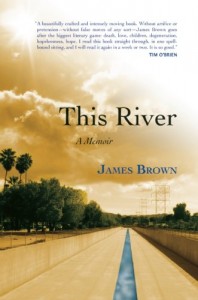
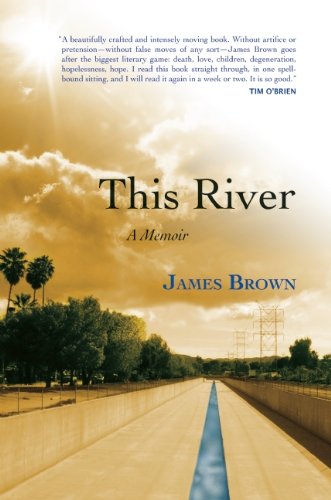
Cover of "This River: A Memoir" by James Brown
By and large, it’s always enlightening when a writer hits rewind and goes back to the beginning and pinpoints a dominant force which eventually took over his or her life. This is what happens in the chapter entitled “Instructions on the Use of Alcohol,” wherein Brown recalls his childhood. The memories start around the age of ten when his parents have a party and Brown sneaks a bottle of Midori, “a thick, syrupy green liquid,” into his room and drinks it and becomes “smarter and funnier and stronger and braver and even better looking,” before becoming deathly ill and passing out. Perhaps it’s not meant to be a humorous recollection, but I found myself chuckling and telling myself, “Yes, that’s kid thinking, yes, that’s the way it is.”
“Instructions on the Use of Alcohol” is a long chapter, moving from initiation to downfall (actually several downfalls) and then to Brown’s later years, when if he doesn’t quit drinking, he’ll certainly end up dying. The insight gained by Brown’s explanations of what was driving him makes this one of the most instructive chapters in the entire book and gives us a well-rooted basis for understanding the behavior he displays in the latter part of the memoir.
In “Remembering Linda,” Brown explores a period when the author was in his early teens and in love with a girl in high school. Her name was Linda Hernandez. She was in foster care, a throw away child having an affair with a man in his twenties. Linda was desperate for love and attention. Brown wanted to tell her that he loved her, but he was three years younger and not brave enough to make his feelings known. Any man remembering his own confusing adolescence will recognize and most likely sympathize with Brown’s teenage dilemma. Who doesn’t remember his/ her first love and how overwhelming it was?
Chapter follows chapter weaving the past into the present, the present into the past seamlessly as the author continues with what must have been at times an excruciating voyage of self-discovery, a voyage occasionally punctuated with moments of an uplifting epiphany. “The Apprentice” describes his closeness with and admiration for his father, a man who at sixty-seven was still repairing roofs and pouring concrete driveways and fixing bathrooms and sewer lines. This is a chapter that reveals the better angels of Brown’s nature. The subtext of what we see happening between Brown and his father says, in effect, that his childhood wasn’t unrelentingly dreadful. Those appalling early years were at least somewhat mitigated by the example of a father who taught him how to work hard and what manhood meant. Brown describes a father whose influence was powerful enough to move his stubborn son away from a labor-intensive career in construction towards the life of the mind. His father wants him in school, wants him to go to college. Brown says: “Part of me wants to break the cycle of the men in our family working the trades and be the first to attend college.” But at this point in his life (he’s seventeen), he just doesn’t believe he’s smart enough to be in college. His father vehemently disagrees and won’t sign the release form that would send his son to vocational school. “The Apprentice” makes clear that there were periodic blessings throughout what was too often a nearly unbearable life.
Blessings that Brown does his best to transfer to his own children, his two sons who accompany him to a river in Oregon, where Brown’s father had taken him as a child. He recreates the father’s careful instructions about how to fish for trout, how to use the reel, the line, the pole the little lead weights, how to bait the hook and where to cast it. Brown meticulously mentors his two sons, taking both comfort and great joy in teaching them what his father taught him: “How to pitch a tent. How to shoot a .22 rifle straight and true. How to string and tackle and bait a hook and where to throw your line for your best chances of catching a fish.” The title of the chapter is “This River,” the title of the memoir itself and the moral center of the book. It’s a chapter filled with love of family and nature. It speaks of the sacred trust handed down from fathers to sons, a duty that obligates us to remember the best of the past and to passing those good memories, our hard won knowledge, on to the next generation.
In a related chapter, Brown describes taking his boys to their wrestling matches and how well they fared on the mat. Brown, a former wrestler himself, is able to give his boy Nate a strategy to win a match in which he is two points behind in the closing seconds. Logan, the other son loses his match because his opponent cheats. In the heat of the aftermath, Brown and the cheater’s father almost come to blows. On the way home Brown feels uncomfortable about losing his temper. Reflecting on the day, he tells us: “I would like to believe that I can offer my sons a better world where there is no racism, no cheating. No parents who teach their children to hate and hurt others. But I can offer them no such thing.“ The wrestling chapter affirms what many thoughtful adults know: it’s a rough, tough world we live in and the best any of us can do is instruct our children in behaviors that might make them suffer less, behaviors that will help them survive the vicissitudes of a totally unpredictable life.
The final chapters reveal Brown’s obsession with bodybuilding and steroids, the use of which turned him into “Some Kind of Animal.” He gives us “Instructions on the Use of Herioin,” describing the process in minute detail. He also describes his attempts to kick the habit and his many relapses. He talks about his continual search for knowledge, his falling back two steps for every step forward, his writing and the degrees he earned which set him on a course to become what his father wanted him to become: a successful professional, an award-winning writer, a Professor of English at San Bernardino University.
This River pulls no punches—art shouldn’t and Brown doesn’t. The good, the bad, the ugly are all there, given to us in a lucid, uncluttered, muscular prose studded with an honesty that can only come from the deepest wells of a flawed man’s incredible willpower and courage. At the end of it all, Brown’s account becomes a story of a man who, against what should have been overwhelming odds, came back from the abyss and not only prevailed but triumphed.
-Duff Brenna

Duff Brenna
DUFF BRENNA is the author of six novels. He is the recipient of an AWP Award for Best Novel, a National Endowment for the Arts Award, a South Florida Sun-Sentinel Award for Favorite Book of the year, a Milwaukee Magazine Best Short Story of the Year Award, and a Pushcart Honorable Mention. His work has been translated into six languages. His short story, “Annette’s Work in Progress” is featured in the Winter 2010 issue, Machismo: A Field Guide.