Krista Steinke is the featured artist on the cover of our latest issue, The Lives of the Saints, (Fall/Winter 2011). Though she is a multi-skilled artist, the photographs that she shared with us are really quite complementary to the writing that we publish in our print issues. In so many of her images, Steinke is able to reach the depth of a story, and to tell it in one shot, one frame. Assistant Editor, Jessica Aufiery, conducted the interview via email, and we are happy to share it with you. We’ll post Part 2 tomorrow! Read Part 2 of our interview here.
When did you first identify yourself as an artist?
I remember coming home from nursery school and announcing to my parents that I was going to be an artist. I don’t think I started identifying myself as an artist, however, until I went to the School of the Art Institute of Chicago in the early 90s. Committing to art school and paying for it entirely myself, made it all seem very serious and real.
The practice of making art is sometimes likened to religious ritual. How important is process to what you do?
Yes, it does seem like that to me which is one reason why I prefer to shoot with film rather than use a digital camera. The process of film photography is much slower, more contemplative, and still feels a bit magical to me. There are several stages to the process from setting up the shot, developing the film, making contact sheets, to editing and printing. But the moment that comes closest to feeling like a spiritual experience is in the actual shooting itself. It is in this stage of the process where I seem to lose myself and outside, unexplainable factors come into play to shape the work. The act of looking through the viewfinder and tripping the shutter is what keeps me wanting to return and start the process over again.
Your use of masks in your series Backyards BB Guns and Nursery Rhymes calls to mind artists as varied as Flemish-Belgian painter James Ensor, and film director Richard Kelly (I’m thinking of his 2001 cult classic Donnie Darko with its demonic rabbit, Frank). What do masks mean to you?
Countless artists have used masks in their art: Picasso, Frida Kahlo, Cindy Sherman, Ralph Eugene Meatyard, Richard Kelly. Masks are loaded with symbolism and endlessly fascinating on both a formal and conceptual level. In my work, the mask functions as a means to perpetuate the narrative and creates a simple way to reference a children’s story or fairytale. On a practical level, they allow my models to easily assume the role of a character and feel less self-conscious in front of the camera. They also disguise the identity of my subjects so that the images have a more universal feel. In essence, the models become anonymous and can represent “any” child. Finally, the use of masks help to distance the photographs further from reality and create uncanny scenarios that hover between dreamscape, performance, and fantasy.

"this little one had none" (from the series Backyards, BB Guns, and Nursery Rhymes), 2006, archival pigment print
You’ve lived in Virginia, Texas, Indiana, Chicago, Maryland, and Philadelphia. Has place had any particular influence on your work?
You can add Chapel Hill, Seattle, New York City, and rural upstate New York to the list. Some of these places, not all, have indeed had a direct impact on my work.
The concept of “suburbia” creeps into my work quite often. For better or for worse, it is where I grew up, and I cannot seem to get it out of my system. In fact, this spring, I am returning to my childhood neighborhood to do a photo shoot on the street where I grew up in Texas, “St. Cloud Drive”. I am also currently working on a series called “Purgatory Road” which is about an actual place in rural New York state where my family spends the summer months. My “Backyards…” series was also shot mostly in this same region. All of these locations are associated with some type of narrative, a personal memory or local legend, and the concept of “place” plays an integral role in the telling of the story.
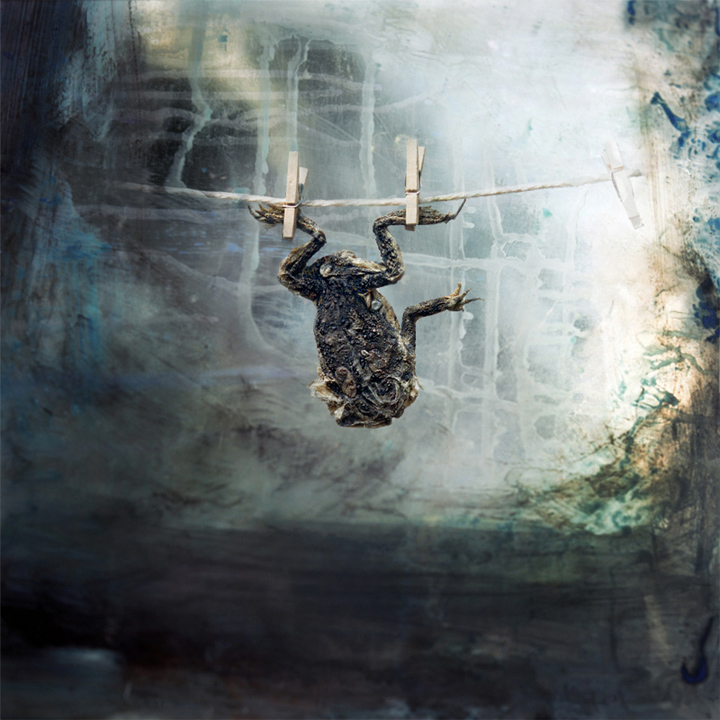
frog, 2011 (from the series "Purgatory Road")
The play of light in abandoned rooms in your “until there were none” series evinces a kind of poetry of the mundane that recalls certain paintings by Spanish artist Antonio Lopez Garcia (ex: Studio with Three Doors). There’s an important distinction in your own work: the toys that inhabit each frame—standing boldly in the center of the space or peeking furtively from a shelf or behind a curtain—add a narrative element that takes these photographs out of the realm of straightforward observation. What story (if any) do you want your photographs to tell?
For this particular series, I was given the opportunity to photograph in an old, deserted office space in the legendary Bethlehem Steel complex in Pennsylvania. When I scouted the site, the place felt peculiar and ominous, but oddly familiar. Each room, with its unusual mix of fluorescent and natural light spilling over debris, torn curtains, empty boxes, and uninhabited furniture, was like a gloomy dreamscape or a scene from a hazy memory. Because I was in the middle of working on the “Backyards” series at the time, my thoughts were very focused on the topic of childhood. The space felt like a post-apocalyptic Never-Never Land, a place where children might be tempted to play but would never dare to explore alone.
I chose “until there were none” (a verse from a nursery rhyme) as the title for this series because it implies abandonment, isolation, and displacement, common recurring themes in fairy tales, myths, and archetypal stories. I intended for these images to read as visual metaphors for fear, anxiety, and other unconscious emotions that often first appear in childhood. My aim was not to illustrate a specific story, but rather to capture unresolved moments, from which viewers must rely on personal experience to interpret the work.
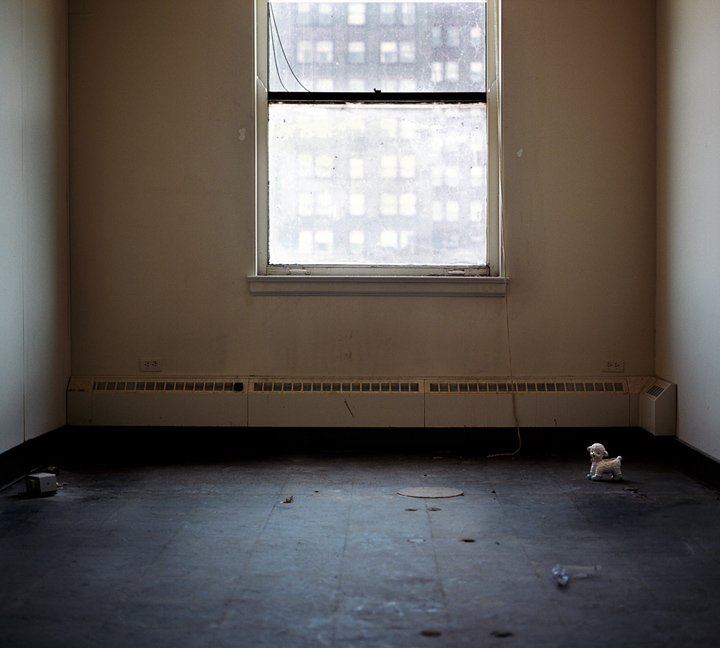
untitled, 2006 (from the series "until there were none"), archival pigment print
Krista Steinke is a Philadelphia-based artist working in photography, video, and mixed media. She was born in Richmond, Virginia but spent most of her childhood in Texas. She received a BA in the Advanced Humanities from Valparaiso University, a BFA from the School of the Art Institute of Chicago, and her MFA in Photography and Digital Imaging from The Maryland Institute, College of Art.
Her work has been included in exhibitions from New York to LA and her time-based work has been featured in film and video festivals around the globe. She is the recipient of many awards and fellowships including the 2009 Pennsylvania Foundation for the Arts Fellowship in Photography, 2008 Finalist for the Photolucida Book Award, and 2008 Artist Residency at Light Work. Her work is in numerous collections, including the Museum of Fine Arts, Houston, Woodmere Museum in Philadelphia, Brauer Museum of Art, Johnson & Johnson Collection, and Fidelity Investments. Her photographs have been published in The Photo Review, SPOT Magazine, SHOTS Magazine, Contact Sheet, EXIT (Madrid Spain), and Monthly Photography (South Korea).
Krista’s work is represented by the Schmidt Dean Gallery in Philadelphia. She is an Associate Professor and Chair of the Art Department at Moravian College. Recently, Krista’s work was exhibited at the Atlanta Jackson-Hartsfield International Airport and she is looking forward to a solo exhibition this coming spring in Houston, Texas during the 2012 Fotofest Biennial of Photography.
Check out more of Krista’s work here: http://kristasteinke.com/

Pingback: Interview with Krista Steinke — The Literary Review | Moravian Art Department