
Adam Wilson is having a busy winter. His first novel, Flatscreen, comes out next week. He made a cameo in his own book trailer. He has stories recently published not only in TLR’s most recent issue, The Lives of the Saints, but also in The Paris Review, The Coffin Factory and The New York Tyrant. Luckily, Adam had time to answer some of our questions, and we’re glad he did.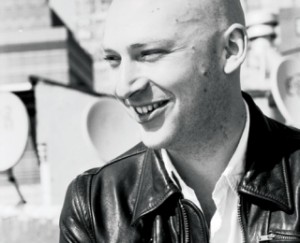
You’ve had two stories published recently - “What’s Important is Feeling” (Paris Review, Issue 199) and “Tell Me” (The Literary Review, Live of the Saints, Fall/Winter 2011) - that are both written in the first person. It seems that your narrators exist both as characters within the stories, and as a collective disembodied voice of the particular zeitgeist that we (most of us) live in. Do you feel compelled (or have you willfully chosen) to write in that “voice”? How important is it, for you, to write in things about the way the world exists for us now (i.e. Facebook friends, checking email after sex, watching movies on a laptop)?
I’m glad you picked up on that. I feel like these characters are almost battling for autonomy against the overwhelming voice of the zeitgeist, and often losing the battle. It’s something I explore more deeply in my novel, this idea that there are these ubiquitous culturally woven narratives that are almost inescapable. I think of these characters-and particularly the narrator of “Tell Me”- as longing for independence from perceived cultural norms (re: relationships and language) but with no outside point of reference on how to achieve that. As a writer, I’m certainly interested in the way the world exists for us now, because I live in that world, and I’m trying to figure out how to navigate it. It also interests me, at least in part, because it’s a world that is still new to literature. Why would anyone read my writing when they could read Virginia Woolf? Well Virginia Woolf could do a lot of things that I can’t, but she couldn’t reflect on checking email after sex. I don’t know, maybe she checked her mailbox. Or maybe she had better sex.
You also write places in Brooklyn into your stories. Is there anything particular to Brooklyn that is fun or engaging or interesting to write about? What’s your relationship to Brooklyn like?
This is something that’s pretty new to me. My novel is set in a made-up suburb of Boston. Because it wasn’t a real place I had the freedom to make up all the names of streets and stores, which was a lot of fun. I’ve always been intimidated to write about New York 1) because it’s been done so well by so many people better acquainted with the city than I am, and 2) because I’m terrible at geography and a lazy researcher. But I’ve lived here for six years now and at least feel comfortable in my knowledge of the particular area of Brooklyn that I live in. In the short time I’ve been in this neighborhood it has changed a lot, and now I feel like one of the old hands who knew it when it was different, though of course there are like five generation of older hands who knew it when it was even more different. In my original draft, “Tell Me” wasn’t set in a particular place, but then I thought: fuck it, it’s Cobble Hill, everyone knows it, the store is BookCourt, why pretend it’s not.
Your first novel, Flatscreen, comes out in February. One of the blurbs touts it as a “slacker novel.” Did you intend to write a slacker novel? What does that even mean? Is it an apt description?
Well, my narrator is definitely a slacker. He smokes a lot of pot and lives with his mom-hallmarks of Slackerdom. But I think he’s of a new generation of slackers who are slackers in spite of being fully aware that they are slackers, and what that word connotes on a cultural level. Maybe he’s a post-slacker. He’s seen all the movies and knows what role he’s playing-and that it’s a shitty role-but he still can’t figure out how to escape it. Self-awareness (or perception of self-awareness) combined with the continuing inability to change interests me.
Gary Shteyngart blurbed that it was a book you’d read on the way to a job you hate, (most likely) because you’d be too smart for that job. Have you had jobs that you hated? Did you write this novel to combat the fatigue from working a sucky job?
Well, when I started writing this novel I was living in Austin, Texas and I had a job holding up a giant orange arrow at a highway exit ramp. That was the worst job I’ve ever had. After that I moved back in with my parents. That too caused a lot of fatigue, which I combated by working on this novel.
What’s next for you? Will you be going on a book tour, giving readings? Any upcoming publications or works in progress you’d want people to know about?
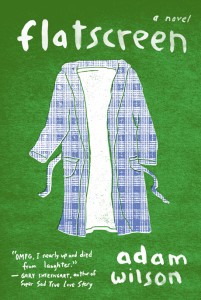 I have a book tour starting in February. The book party is at Bookcourt in Brooklyn, where I used to work, and where “Tell Me” is set. February 21. There are more NY events, as well as some in Massachusetts. You will be able to find all of these on my website adamzwilson.com. I have some other new stories out currently, one in The New York Tyrant called “The New Me”, that is sort of a companion piece to “Tell Me”. The other is in this new magazine The Coffin Factory, which I think is beautifully made and features some really great writers. And I’m deep into writing a new novel that centers around the Wall Street crash, the rapper Eminem, and the epistolary relationship between a young woman who works in marketing and a death row inmate in Texas. Should be fun stuff!
Adam Wilson’s first novel, Flatscreen, will be published in February 2012. He is the editor of The Faster Times, and his works appears or is forthcoming in The Paris Review, Bookforum, The New York Times, The New York Observer, Washington Square Review, The New York Tyrant, and many other publications.
Watch the trailer for Flatscreen here: http://youtu.be/GRmfeWf6fBw
Stalk Adam in real life: http://adamzwilson.com/42459/events
