
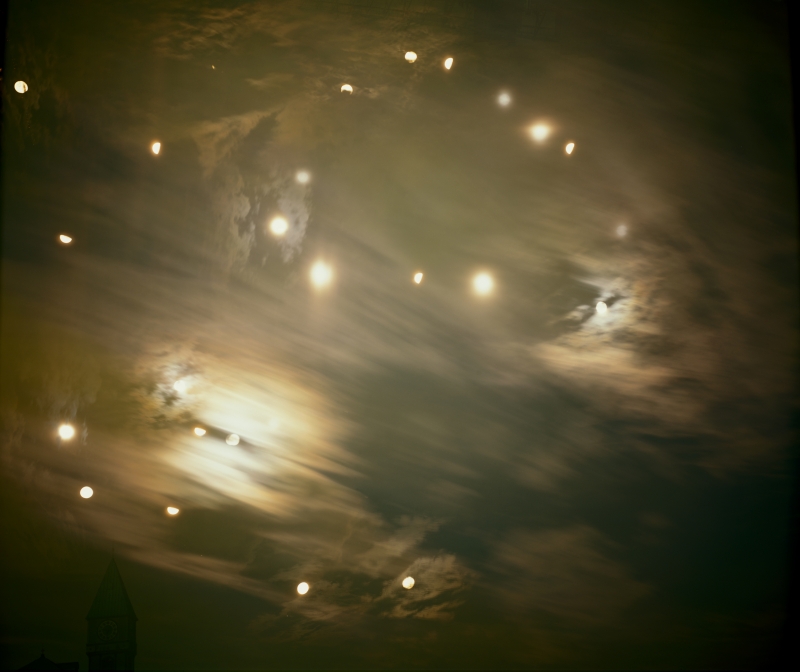
Sharon Harper's extraordinary "Moon Studies No. 1" which appeared on the cover of our Spring 2010 issue, How To Read Music
Kelly Cherry
What the poet wishes to say
What the poet wishes to say cannot be said,
in part because it has been said, and often,
before, but this was true when only the second
poet wrote. It becomes no truer with time.
The bigger reason the poet cannot say
what she wishes to say is that she wishes to say
something that seems to be a kind of music,
a word-field of music, as it’s less a text
and more a space of time profoundly charged
by feeling, like the awe attendant to
our modest place among the huge events
of universal import: stars and novae,
the initiating burst of Many from
the One-the one what? Impacted point,
or god, or some computer-generated
simulacrum? In any case, the whole
of it.
If everyone could speak the whole,
then everyone would speak poetry, but
Moliere’s gentilhomme was perfectly pleased to learn
he had been speaking prose.
Even for those
whose language is poetry, the task requires
a life of: practice, contemplation, prayer.
(The latter two are sham without the first.)
This life begins in echo and extends
into apprenticeship, a period
that may be short or long but always ends,
if it ends, with the achievement of a vision
or “showing,” as Julian of Norwich called her visions
of Jesus Christ, but we prefer “a view.”
(Transported as we are by art and music,
the leap to faith remains a leap to faith.)
So say “a view,” a world view if you must,
but know that you are only halfway home.
Even with the view. Even speaking poetry.
Because poetry is not the only language
you must master. You must also learn
the personal language that will convey your view,
and since your view, so similar to the ones
you love, also differs from them, if only
because the time in which you live and write
is different, you must invent that language,
hoping a few readers follow on the same
path and perhaps they will and perhaps they won’t.
But how to make a language of your own?
In short, the process has to do with rhythm.
The racing rhymes of Dante’s terza rima
so magnifies the interlocking of
hell, earth, and heaven that the universe,
the medieval universe, becomes one verse.
And Chaucer’s Wife of Bath is like a laugh
so full and deep it shakes the ground of England.
And Will, whose way with words created English,
creates as well the tense, or rueful, clash
between the life of action and the life
within the skull, that secret, teeming world.
Or consider a poet less removed
in time, whose reputation for that reason
is hard to know, yet Osip Mandelstam,
arrested and in exile, begging food
and blankets, honed the razor of his lines.
Discussing Osip, poet Joseph Brodsky
notes, “Whatever a work of art consists of,
it runs to the finale which makes for its form
and denies resurrection.”
This is true
and not true, as it is, too, when he writes, “After
the last line of a poem, nothing follows
except literary criticism.”
Both statements are rather more clever than correct.
What follows a poem is often a poem in response.
It’s possible to write a poem that enacts
its own resurrection.
As for the poet,
the poet aims not at immortality
of self or reputation but of what
he or she wishes to say, the world as it was,
or seemed to be, on that day in mid-October
when the hills were still green, the wildflowers
scattered like birdseed from a hand not seen
nor felt, and the various, changing, falling leaves
swirled up again, caught in a sudden updraft,
then settled on the ground like immigrants,
a huddling, a community of color.
A day when a small boy rushed to open the door
to shout “Bonjour, Madame!” to a woman whom
he’d never met and waked in her a feeling
of sheerest joy, salvific and abiding.
The poet wishes to say what life was like
here on the planet in the twenty-first
disturbing century and might, to do
so, think of her beloved Beethoven,
who, deaf and lonely, brought his art to such
sublimity, it is as if he wrote
his music among the spheres of music, working
at a desk of sky, the innumerable stars for lighting,
a gust of solar wind sending manuscript
flying. In the late piano sonatas,
you hear the composer placing his notes, solid
and silken as they somehow manage to be,
without hesitation but with deliberateness
exactly where they are supposed to go,
thereby fixing the apparatus of heaven
God had let fall idle.
“What The Poet Wishes To Say” appeared in our Spring 2010 issue, How To Read Music.