
The other day I entered my local bookstore to find José Saramago’s new novel, The Elephant’s Journey displayed prominently on the front table. At the time I wasn’t thinking about his death this past spring, or the intricate and lovely elephant on the cover, but instead, about how much I love gliding into his worlds. I lifted the book and rubbed the cover, kind of as a hello: Hello old Friend, author I adore. I flipped the book over and back without reading any of the blurbs and returned the book neatly to its stand. I did not buy the book. But I really, really wanted to.
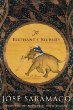 I wanted to buy the book not because I wanted to read it specifically, but because I love coming home from the bookstore with new book in hand, barely able to contain my excitement, and just plunge into the new story I’ve selected for myself. It’s not even totally about escaping; partially it’s about consumerism, like wearing a pair of new jeans the morning after you buy them. They’re the newest thing you own and should be worn. I love, just as much as I love any of the authors I love, buying a new book and reading it right away.
I have a hard time buying only one book, so what stopped me from buying Saramago’s last book was that on my nightstand there is a pile of unread books—books I’m saving for when I have time to indulge in reading just for myself—and one was Saramago’s Seeing released in 2006 (the others are by Cormac McCarthy, Mary Karr, Elena Ferrante, Jane Smiley). Needless to say, I thought to myself, I should read Saramago right this moment, but I should read the book I already own.
 I needed this kind of jumpstart, the excitement of almost buying a new book, to get me back to Seeing. Saramago is always a hardcore read, with his awkward syntax, the lack of quotation marks, or periods between speakers, or sometimes without attributions to indicate who is speaking. The paragraphs are often pages long. I have to be in the mood to read him. I have to want to work.
The other reason I’ve been avoiding Seeing is because it is a sequel to his Nobel Prize winning novel, Blindness, and I am weary of sequels. I don’t trust they’re necessary—after all one book’s finished, complete, all the characters and plots have run their courses. I loved the other books of Saramago’s I’ve read: Blindness, The Double, The Cave, All the Names. I love the difficulty of his writing, but more the way that people correct each other’s grammar and say all the things that most writers delete or never write:
What did you make of the old man, He’s old, and that’s about all there is to be said about him, There you’re wrong, there is everything to be said about the old it’s just that no one asks them anything and so they keep quiet, Well, he didn’t, Good for him, carry on.
I hate to spoil that perfection with an extraneous sequel.
As with Blindness, in Seeing Saramago is interested in internment and locking people away to avoid the spread of a plague, but whereas with Blindness it was to avoid the spread of a white blindness—a true disease—in Seeing it is simply political ideas, or rather the casting of blank votes by 83% of the population, which is considered contagious. The government flees to the city boarders and barricades the city population inside, certain that the inhabitants will self-destruct and come crawling back to their leaders.
This novel is endowed with Saramago’s signature surly wit and love of the ridiculous. Take the following response from an interrogator to a man thought to have cast a blank vote when the man mentions that “hope is like salt”:
“if hope is  like salt, what do you think should be done to make salt like hope, How would you resolve the difference in color between hope which is green, and salt which is white” and then later “let’s go back to the salt and hope again, how much would you have to add before the thing you were hoping for became inedible.”
The logic of those sentences makes me feel oddly at home, because it rings so true to the way people are crazy and illogical when they’re trying to make a point. Sentences like those seem like keys to discovering what is wrong with all the people in the universe.
The problem was that along with that charming relaying of irrational logic, there is, until about a third of the way through, not that much of a narrative pull. The ideas are interesting, but the story is slow. And I like slow sometimes, but Blindness was not slow. Which made me cranky, because it reinforced why I don’t like sequels.
But also it reinforced what you can do with a sequel. What is beautiful and disturbing about reading Seeing after Blindness is that since the first book is so violent and caustic I was kind of waiting for horrific things to happen. I was literally thinking, I wonder if there will be murder. I wonder who will be raped. And I could ignore those nasty thoughts until I realized that it wasn’t only me who was missing the violence, but the government who had pulled out of this unnamed city was also frustrated by the peace within the borders of a city lacking any law enforcement. Which made me kind of complicit when the President, Prime Minister and Interior Minister decided to insight the violence themselves. What’s under examination here then is not just why people are violent, and how they are violent, but why they, perhaps, crave violence.
For the last two thirds of the Seeing, the characters from Blindness play a pivotal role; although the books stand alone, I would suggest reading the prequel first. Placing the two works together not only helps to create emotional resonance in the sequel, but it multiplies the meaning of Blindness—a gruesome, fabulous novel in its own right. Seeing expands the breadth of what people are willing to do to each other to maintain control—either over their own lives, or the lives of others.
Now, back to the bookstore.
—Jena Salon
(Jena Salon is TLR’s Books Editor. She lives in Philadelphia.)