 There are plenty of books I haven’t read that I should have. I can find a lot of places to lay the blame: for instance, I moved seven times before I was fourteen, and therefore missed a number of important books being taught: I missed Romeo and Juliet my freshmen year. I missed The Old Man and the Sea. I could have gone back to read these books later on, but from other students’ accounts I felt that I had escaped the bullet of boredom these books would have been to my brain. I could blame, also, my sister, who was a reader sucking up everything from Jane Austen to Victor Hugo before she was thirteen. She was the reader, I was not. It was important to keep our identities separate.
I read all Kurt Vonnegut had to offer. And all of Margaret Atwood. You see where this is going. I went to college with the intention of becoming an English major but dropped out because English, it turned out, meant written in English first, and also, Old. I didn’t like Canterbury Tales. I didn’t want to swoon over Shakespeare’s women. I liked foreign literature, books in translation. I liked contemporary. I loved the rush of lyric language and dark content that Western European, Russian and South American literature seemed to support. I fell in love with Antunes’s The Natural Order of Things and Bulgakov’s The Master and Margarita. Even in original English my taste ran to Marilynne Robinson’s Housekeeping or Ben Okri’s The Famished Road.
Which is still where my aesthetic lies.
But I see that I have a huge hole in my reading and I hate the embarrassment that comes when someone asks if I’ve read The Iliad or 1984 or Jane Eyre. Which I haven’t. At one point I had designed a plan to read one contemporary book and then one older book, but the plan fell away.
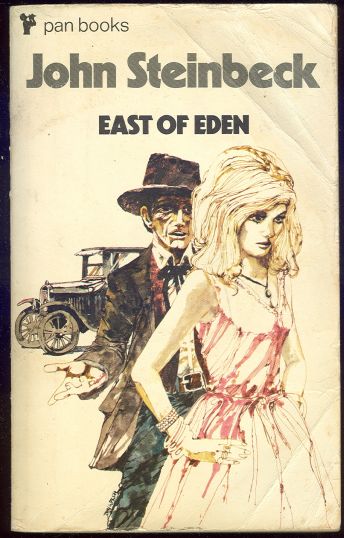
 All this to say that I have just read East of Eden by John Steinbeck (no! I haven’t read Of Mice or Men or Grapes of Wrath). A friend gave it to me calling it “a potboiler” which I always love because he never says that about short books, only books which are 600 pages long. It’s usually enough incentive for me to stick with it (he was completely right, after all, about Crime and Punishment). About East of Eden, he was right too.
What I want to say about this book is maybe just, look at this sentence:
“The Salinas was only a part-time river.”
Awesome.
By which I mean, this is Steinbeck’s forte—clear, concise writing, that tells us simply the state of the world, without giving in to even the dullest of details. A river dries up, flows again. And yet there is an unimaginable beauty created in the recognition of this fact.
What is more amazing about East of Eden, though, is what my friend failed to mention about this potboiler: it manages to be riveting while basically taking the form of a character-study. Steinbeck twists our emotions so that characters we hate or are scared of early on, we are drawn to and moved by later. Characters we love early on later seem foolish, and sad. He loves each of his characters, despite their flaws, so that they become real. With each new character introduced we are immediately drawn into the story, and when he tangles these characters up together, the tension is palpable.
—Jena Salon