
DEEP FOCUS
Q & A WITH TLR
SHORT STORY-WRITER
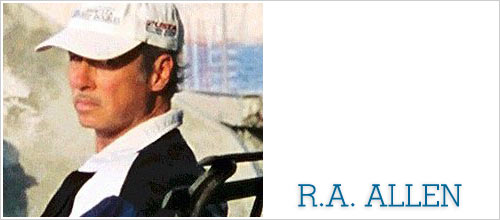
R.A. ALLEN
R. A. Allen’s “Emerald Coast” (from our Fall 2009 issue) was recently selected for inclusion in Best American Mystery Stories, 2010, edited by Lee Child and Otto Penzler.
Beneath the wealth and glamor of the American celebrity lies a world full of intricacies of its own—a world of deviants—independent from media approval ratings. This realm offers horrors, truths, and legends of its own. There is no better way to understand this landscape than through the detailed observation and crystalline writing of R.A. Allen’s short stories. It captures the maverick character (and characters) of this underbelly, with imagination and originality. A man spontaneously combusts in a bar in front of a drunken audience. Two slightly rotten ex-cons hiding, as Allen writes, “from the angry finger of societies’ god” find redemption in a fight to save a woman’s life. These are risky and extraordinary stories.
R.A. Allen lives in Memphis, Tennessee. His fiction and poetry have appeared or are forthcoming in The Barcelona Review, The New York Quarterly, Pear Noir!, Word Riot, Underground Voices, and others. Two of his stories, “Monday Burning” and “The Emerald Coast,” were published in The Literary Review. He agreed to give us a more extensive contributor’s note in the form of this mini interview.
— Anastasia Cyzewski
What inspires you to keep writing?
Having someone publish my work. It is this feedback that tells me I’m getting better. And, of course, reading the work of other writers.
Is there a writer in particular you admire, or who we can see in your work?
I admire too many writers to list them here. And they all influence my work, closely. I am one of those people that you occasionally see in airports or cafes underlining sentences in books, often while muttering to themselves. I collect the techniques of others, i.e., how is Lethem or Shacochis describing a character who is doing or thinking about a specific thing on page x? I record these interesting examples and, after filing off the serial number and applying a different coat of paint, use them in my own writing.
How would you say living in the South influences your writing?
The South has always been an interesting place and, in my lifetime, it has gone through some interesting times. Per force, living in the crucible of interesting times makes you more observant, if only out of self-preservation.
You have almost a signature style. The protagonists are deviants, who don’t quite fit society’s ideals. Still, I find it easy to connect with these characters. Is that because they’re based on real people?
Ah, deviants I have known… I’ve been employed in many occupations that brought me in contact with the public. And that’s where the deviants are. Over the years, I have captured some memorable types and locked them away in a cerebral file labeled “characters.” When needed, I’ll scrounge one up, sprinkle him with the dust of poetic license, add some honesty, and voilà!—a protagonist. Warning: They can be hard to control on the page, acting more like the antagonists they naturally tend to be.
As for the characters themselves, yes, my characters can be thinly disguised versions of people I know. They can also be compilations of multiple people that I know, or only know of. Sometimes they are an exaggerated, subdued, or shaded version of me.
Do you have some advice for writers that are trying to be published?
It’s going to tough to come up with anything original or even inspirational on this one, so I can only pass along what I learned from other writers and what eventually worked for me: Keep Trying. Also, try not to think about the rewards too much.